I learned violin as a kid and skipped all the hard parts. At 40, I went back for them.
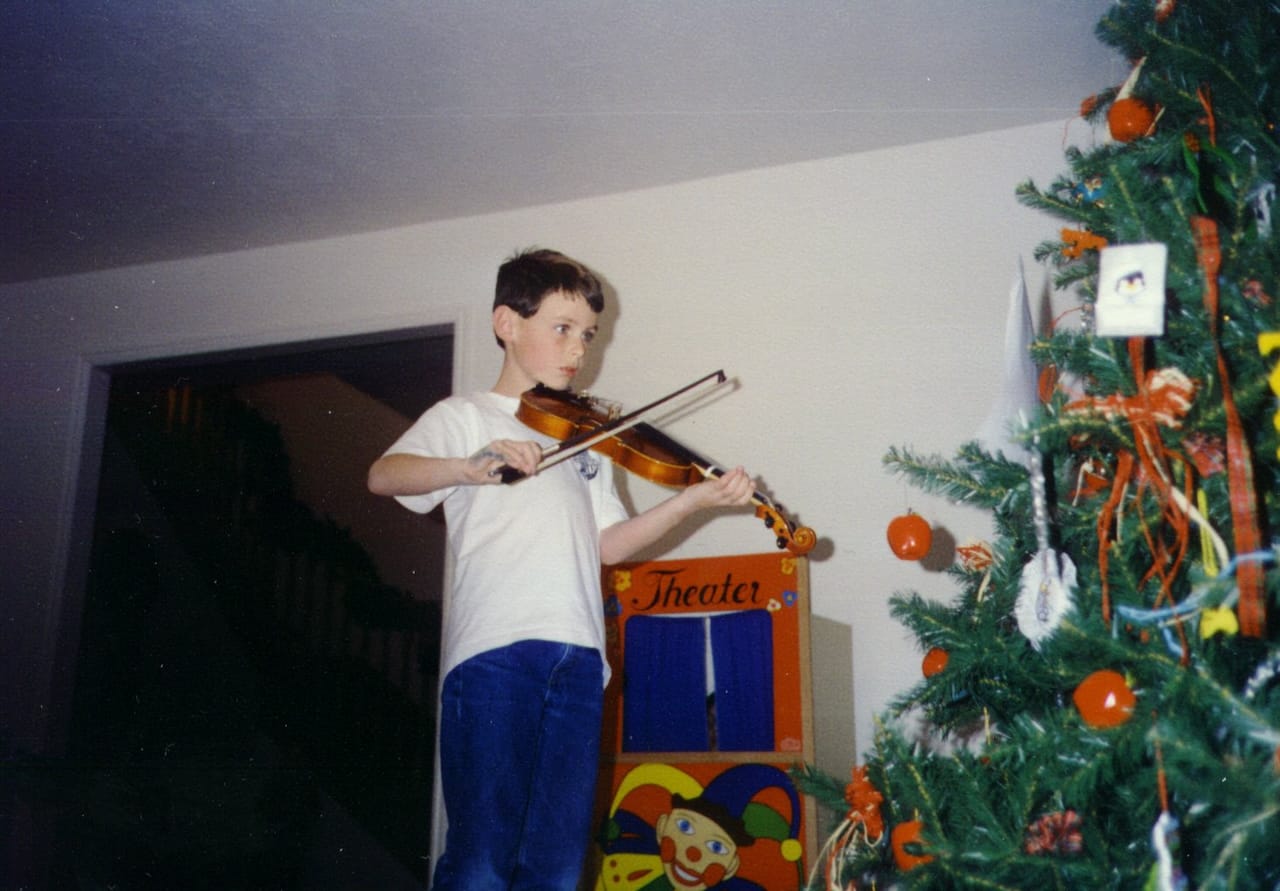
I studied violin from age 7 to 18.
Eleven years. But I skipped a lot of fundamentals.
Not on purpose, exactly. I loved playing the violin. In fact, I wanted to play so badly as a 7-year-old that I convinced my parents to let me skip the traditional 2 years of mandatory piano lessons and jump right in.
My teachers were kind and capable, but nobody made me learn the theory, or the scales, or the arpeggios, or any of the systematic technique that turns a kid sawing at a fiddle into someone who actually knows what they're doing. So I played. And I loved playing.
I continued playing after high school. In the college symphony, then in community orchestras, and the occasional church number. But I stayed exactly where I'd always been: a low-intermediate player with a decent tone and no foundation.
Then in 2025 I picked it back up. I'd been playing more often, and I felt limited in my playing.
I wanted to go back and learn the parts I skated past the first time. So I found a teacher who wouldn't let the fundamentals slide. He's a professional, the kind who corrects the way you hold the bow in the first five minutes and tells you your tone will never improve until you learn to fix that.
Improving at violin is a lovely intention.
It also turned out to be way more difficult than I expected.
If you're looking for a way to spiral into depression, try learning violin. Or playing StarCraft II...
The problem isn't the teaching
My teacher is extraordinary. Twice a month I sit in his studio and he hands me more good, specific, hard-won correction than I could possibly absorb. Things like:
- Keep the fourth finger hovering
- Don't lead the shift with your wrist
- Transfer the stickiness of the bow when you cross strings
- The diminished-7th arpeggio is all minor thirds so listen for the interval.
- And on, and on, and on....
And then I'd go home.
And by next Wednesday I could remember maybe two of the six things he said. By the next lesson, most of it had evaporated. I'd walk in and he'd have to re-teach me a correction I'd already been given, because it had never made it out of the room.
The teaching wasn't the bottleneck. I was. Or rather, the empty space between lessons was, where thirty minutes of practice, five times a week, kept dissolving into "um, what should I work on today?" and a vague noodle through whatever felt good.
Thirty minutes. Five times a week. That's a small budget. Small enough that wasting it actually hurts. And I was wasting too much of it.
So I did the thing I do.
What I built
I keep everything in a notes vault. It's one big interlinked pile of markdown files where the rest of my life already lives. So the violin got a folder.
The whole thing runs on one idea: the teacher is the richest resource I have, and I was letting it go to waste. Everything else is plumbing to stop that from happening.
Three moving parts.
The lessons log. Right after a lesson — in the car, phone in hand — I dictate or type everything he said. Messy, unstructured, whatever order it comes out. An iOS shortcut drops it straight into the vault as a dated file. No app-hopping, no "I'll write it up later" (I never write it up later).
The practice plan. One file. Current Plan. It's the single source of truth for what I'm doing right now, and it's built from the freshest lesson. This is where I lean on AI: I hand it that messy dump and it parses and organizes the chaos into a clean plan, slotting everything into a template I built. When a lesson changes things, I archive the old plan and generate a new one. There's always exactly one live plan, and it's never stale.
The practice journal. One entry per session, dictated again, in my own words. It's a record of what I actually did, what felt weak, what went well, questions I run into. ("Fourth finger on the G string is still a huge weak spot… but it's getting ever so slightly better.")
That's it. Capture the lesson. Turn it into a plan. Log what happens. Repeat.
The part that made the biggest impact
The template is dead simple. Every session has the same four slots, in the same order. Bow exercises. Scales and arpeggios. One technique. Then music. Always those four, always that order.
Why does that help? Because I never have to decide. I don't walk in cold and negotiate with myself about what today should be. The framework already answered it. I just start.
The template also lets me pick one rotating emphasis for the week. It sits on top of all four slots and decides how I play them, not what. Some weeks that's hand frame, or the bow's sounding point. Right now it's detailed intonation. So I run a B-flat drone under everything and the bar stops being "get through the material" and becomes "are you actually in tune?" Some days that means I play one arpeggio. Or even just one or two octaves of one arpeggio. Slowly. Locked to the drone, hunting for the note until it rings.
That would have felt like failure a year ago. One arpeggio in thirty minutes? Now it feels like the whole point. Slow and in tune beats fast and approximate, every time.
What I actually fixed
I want to be careful here, because it would be easy to make this sound like the system is the achievement. It isn't. At least, I keep telling myself that, because boy, do I love building a fun system... The practicing and the improvement are the achievement, even though I'm still very much low-intermediate, still losing the fourth-finger battle on the G string most days.
But something did change. The corrections stopped evaporating. I show up to lessons and we build forward instead of re-covering ground. The thirty minutes has a concrete plan now. I never have to wonder what to practice. And on the good days I can actually hear when I'm out of tune, which, if you'd asked me six months ago, I'd have told you was just something other people could do.