Designing a system for capturing insights
This is not PARA, this is not Building A Second Brain, this is not a personal knowledge management system, this is not a zettelkasten. I have a particular problem I want to solve.
The problem
I regularly have ideas or insights while reading, reflecting, or going about my day, but I don’t have a trusted, frictionless place to capture and store them when they occur. This makes me feel scattered and unsure of what to do with my thoughts.
I want a system for these insights and ideas that is as trusted, as frictionless, and as functional as the system I have for capturing and completing action items in my life.
Asking ChatGPT to interview me like a product manager
When I’m doing research like this, I prefer to speak out loud to ChatGPT, but I use the dictation feature, not voice mode. It lets me work faster. Here’s my opening salvo:
I am trying to articulate the requirements that I have in my life for recording information and reference materials. Think Tiago Forte's Building a Second Brain or Para system. However, I don't know if I have the same needs as the people who benefit from that particular system. Please interview me like a product manager to help me understand what I need before I even think about a solution. In this case, a solution could be either a process or a tool or a combination of both. Interview me about what types of information I want or need to capture, how it will be used later, etc. Does this make sense?
The resulting interview consisted of 28 questions ranging from, “What prompted this question? Was there a recent moment, frustration, failure, or realization that made you think: ‘I need a better way to record or hold onto information?’” to “What is the maximum amount of friction you’re willing to tolerate capturing an idea in the moment?” to “Do you want there to be any connection between this insight-capturing practice and other parts of your life, such as your journaling practice, your writing or essay work, or client work?”
Design principles
The output of my interview with ChatGPT was the following set of design principles, which I think adequately capture what I’m going for, even though I’m not in love with them. Perfection is the enemy of progress, as they say.
- Capture must be frictionless and thought-free
- The Inbox is sacred: there must be one trusted inbox for raw insights
- Capture and sense-making are separate phases
- Review is for meaning, not organization
- Context is optional and lightweight
- Trust comes from searchability, not structure
- The system must disappear in the background
I found the following line from ChatGPT to be kind of funny:
You are not building a knowledge system. You are building an insight compost pile.
I think it picked up on my personal knowledge management (PKM) anxiety and my tendency to focus on building systems instead of using them. I don’t want to spend hours configuring Obsidian or Notion or any system. I just want to capture my ideas and move on with my life, trusting I’ll be able to find them again later.
Process before tools
At this point, I’m fighting the urge to go fiddle with Obsidian, Day One, or Apple Notes. No! Let’s figure out the process first.
ChatGPT encourages me to answer these questions:
- What happens at capture?
- What happens between capture and review?
- What happens during review?
- What happens after review?
And here’s the process we came up with (initial draft by ChatGPT, edited by me):
- Capture (anytime, anywhere). When an insight occurs:
- Inbox accumulation. Captured insights accumulate untouched.
- Review (weekly, when I journal, whenever)
- Develop ideas (if I want to). For each chosen idea
- Raw inputs persist silently. After review:
- Optional downstream use. Occasionally a developed idea:
Evaluating existing tools against my requirements
Candidate apps are a dime a dozen. So for my evaluation, I’m going to stick with tools that I’ve already used and have familiarity with. That familiarity will help me rate them against my requirements.
A tool is acceptable only if it:
- Has a single, trusted inbox
- Allows single-tap and type or dictation inputs, mobile and offline
- Requires zero decisions at capture
- Supports session-level context
- Supports slow, reflective review and additional writing
- Can fade into the background (does not tempt me to tinker or endlessly configure)
- Is searchable and reasonably future proof
The candidates
- Apple Notes
- Day One
- Obsidian
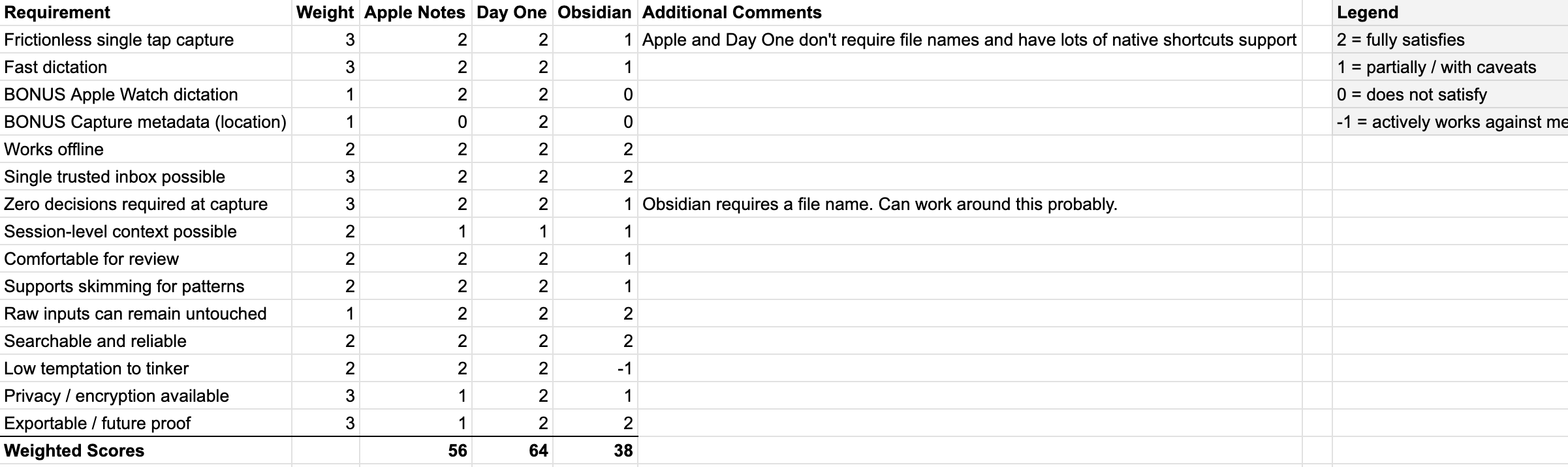
Here’s my completed weighted decision matrix. I think it’s pretty accurate based on my knowledge of the tools in question. I was surprised how improvements to Apple Notes in the latest version made this a closer call than expected. In the past, I’ve suffered immense frustration at not being able to capture Apple Notes on the Apple Watch, but that is now a supported feature.
The tool I selected
Looks like Day One came out on top, based on my personalized requirements, though I’m convinced Apple Notes would also work well.
I did not consider cost, and if I were not already a paying customer of Day One Premium, that would have maybe pushed me toward Apple Notes.
All tools scored equally poorly at session-specific context possible. This is a bit unfair, as all three can likely be augmented via iOS shortcuts or native templates to accomplish this. However, I have not got that far yet. Perhaps before making a final decision, I will try to build a solution for session-based context OR decide that it is not that important to me. That may be best addressed with a process modification rather than a tool configuration. For example, after a context session finishes, maybe I group entries by tag or folder (all three apps support bulk editing entries by tag and location).
Additional context and considerations
Lately I’m trying to understand what role note taking should have in my life. I have highly functional processes for managing my money, my tasks, and my time, but I have been wandering in the wilderness of personal knowledge management (PKM) for years with very little to show for it.
I’ve watched many dozens of YouTube videos on the topic. I’ve taken Tiago Forte’s course on Building A Second Brain. I’ve explored all kinds of tools including Evernote, OneNote, Notion, Roam Research, Apple Notes, and Obsidian.
No matter what I try, nothing seems to stick.
That frustration is what led to this exercise today.
It seems like the pain that drove me to this point was primarily driven by a desire to capture insights and ideas, but I did not consider the capture of reference information such as:
- The gate code to my friend’s house
- My mom’s pie recipe
- User manuals
- Passwords (jk!)
There’s no reason any of these three tools couldn’t capture this type of information, but I’m not yet sold on the idea that I want my insights and reviews to live inside the same filing cabinet as user manuals and recipes.
That might be a question to explore further on a different day. For now, I’ve come to a stopping point.
Next step: implement my plan.